
Answer:
Clearly, biomechanics provides an avenue to individually optimise ball speed following the serve. During preparation, manipulating COM within a wide BOS supports individual stability and induced knee flexion. Ball toss upwards of 3.59m, increases the resultant KE of the ball, greatly influencing ball horizontal velocity following contact. Additionally, during loading, increased lateral flexion of the trunk, bilateral knee flexion and ankle dorsiflexion were staples of the essential bow technique, manipulating COM to increase the time of force application, and resultant impulse. Paired with the foot-up technique, individuals exhibited 11° less knee extension over the foot-back method, coincidentally increasing elastic potential energy and decreasing MOI, facilitating later angular acceleration and force application. Furthermore, during the cocking stage racquet drive downwards behind the player, increases the future incidence of work and power.
Moreover, adopting a throw-like motion aids angular momentum generation and resultant ball linear velocity, unlike a cohesive push-like movement maximising utilisation of elastic PE. MOI manipulation is vital during acceleration, as the angle of elbow flexion and shoulder internal rotation must be regulated to decrease MOI and increase angular momentum, yet arm length must be individually maximised to optimise torque imparted upon contact. However, the ball’s trajectory is equally important, with a contact point below the horizontal, approximately -6.8° dependent on individual factors, relative height and force generation, deemed appropriate, yet induced topspin detrimentally affected ball horizontal velocity. Additionally, active follow-through is also vital to reduce injury likelihood and aid reactivity.
Further Applications:
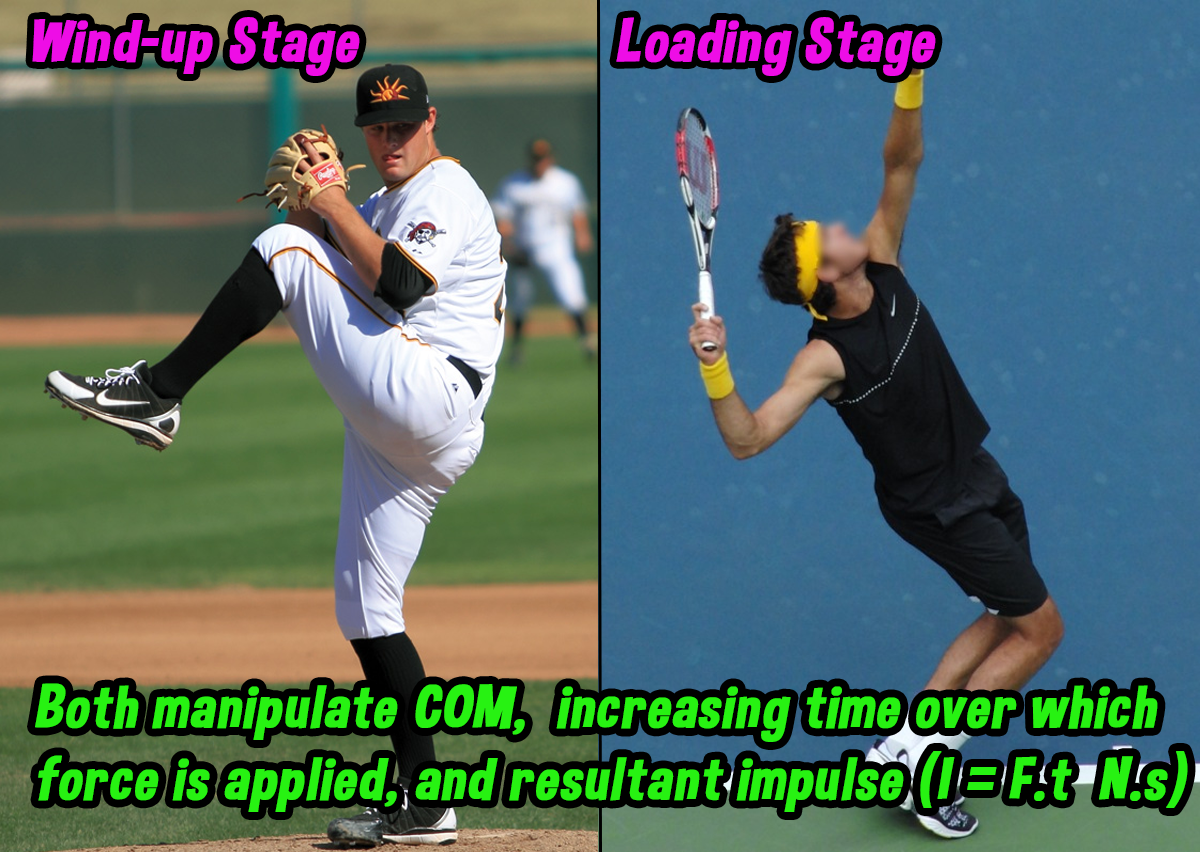
Furthermore, the applied biomechanical principles hold merit during the baseball pitch, a motion reliant on a combination of movement phases, foremost cocking the arm, thereafter, relaying KE through the pitch (Fleisig & Escamilla, 1996). The wind-up stage evident in Figure 12 reflects loading during the serve, the leg is raised increasing the time of force application, supporting a greater angular impulse, similar to the alteration of server COM (Seroyer, et al., 2010). Moreover, the baseball pitch supports a throw-like movement, as successive limb segments periodically increase in velocity (Seroyer, et al., 2010). However, unlike the serve, the baseball is released at a reduced relative height and exhibits an angle of projection above the horizontal, yet vertical velocity remains reduced under a low release angle, favouring the horizontal trajectory. Furthermore, contrary to the flat serve the Magnus effect sees merit in volleyball as topspin is favourably applied, diverting the ball’s path downwards (Kao, Sellens, & Stevenson, 1994). Clearly, these principles are omnipresent in most ball sports including: volleyball, baseball and basketball, yet each sport requires unique, individualised application.
These principles can also be applied differently whilst tailoring training to one’s anthropometric, or intrinsic qualities (Sánchez‐Muñoz, Sanz, & Zabala, 2007). Although analysis suggested distance between the shoulder and ball should be maximised upon contact, children are disadvantaged with a larger racquet and resultant radius of gyration because of their reduced muscle mass (Groppel, 1986). Similarly, learners may favour the foot-back technique documented during loading, increasing their BOS whilst learning appropriate acceleration and follow-through. These principles also provide cues for external training. Torque is directly proportional to force production; therefore, strength training focussed on the shoulder and trunk would aid force production, yet increases in distal mass may be unfavourable under increased MOI (Marques, 2005). Thus, this biomechanical analysis has not only conveyed means of optimising individual force production and resultant ball speed, rather equally offers avenues to account for individual idiosyncrasies.
 HLPE3531 Tennis Serve Analysis